
What Are the Benefits of a Multi-Level Deck?
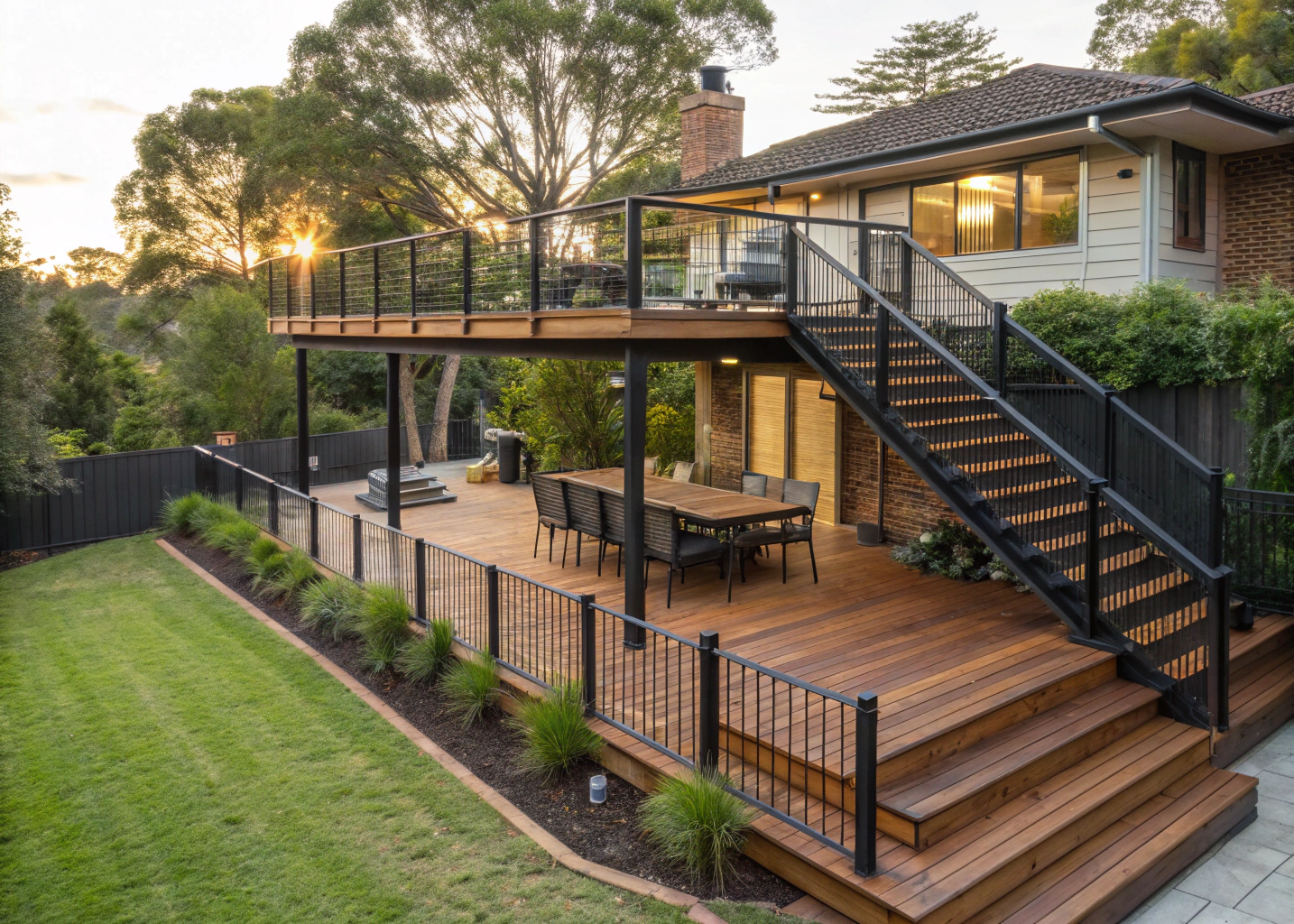
A multi-level deck creates distinct outdoor zones across a sloped or uneven site — removing the need for costly excavation or retaining work while maximising usable space and views. For Newcastle properties with significant ground fall, split-level construction is often the most practical outdoor solution available.
Key benefits of a multi-level deck:
- Terrain adaptation — works with your block’s natural slope rather than fighting it, avoiding expensive earthworks
- Zone separation — each level serves a defined purpose: upper dining, mid-level lounge, lower pool or garden access
- View maximisation — elevated tiers capture Newcastle’s coastal and bushland outlooks that a ground-level deck would miss
- Property value — tiered decks add usable outdoor area and architectural depth, both valued by Hunter Region buyers
- Compliance-ready design — built to meet structural requirements and AS 1657 stair and handrail standards across all levels

Why Newcastle's Terrain Makes Multi-Level Decking the Practical Choice
Newcastle’s landscape shapes what’s possible in a backyard more than most people realise.
Sloped Blocks Across the Hunter Region
The inner suburbs — Merewether Heights, Adamstown Heights, Bar Beach, The Hill — sit on ground that rises and falls steeply between streets. Further out, the hillside suburbs running down toward Lake Macquarie carry the same story. Blocks with a 2–4 metre fall from back fence to house are common. On these sites, a single flat deck platform often isn’t enough to make the space work.
When a Single-Level Deck Doesn’t Work
A single-level deck on a sloped block tends to leave most of the yard inaccessible below it. There’s no connection to the garden, no path to a pool, and no way to use the fall to your advantage. The deck becomes an island. A split-level design changes that — each tier steps down with the slope, opens up the yard, and gives every part of the space a purpose.
How a Split-Level Deck Is Designed — Zones, Levels, and Flow
Good multi-level deck design starts with how you want to use the space — not how it looks in a photo.
Defining Each Level by Function
Before a single post goes in the ground, each tier gets assigned a purpose. The upper level typically connects directly to the home and works best as a dining or entertaining area. A mid-level landing suits a lounge zone or outdoor seating. The lower level handles pool access, garden connection, or a play area for kids. When each tier has a clear role, the whole deck flows naturally from one space to the next.
How Many Levels Do You Need?
The number of levels isn’t a design preference — it’s driven by how much your block falls, where your home’s entry and living points sit, and how you plan to use the yard. A 1.5 metre fall might need two levels. A 3 metre fall typically calls for three. We work this out during the site assessment so the layout suits your block, not the other way around.
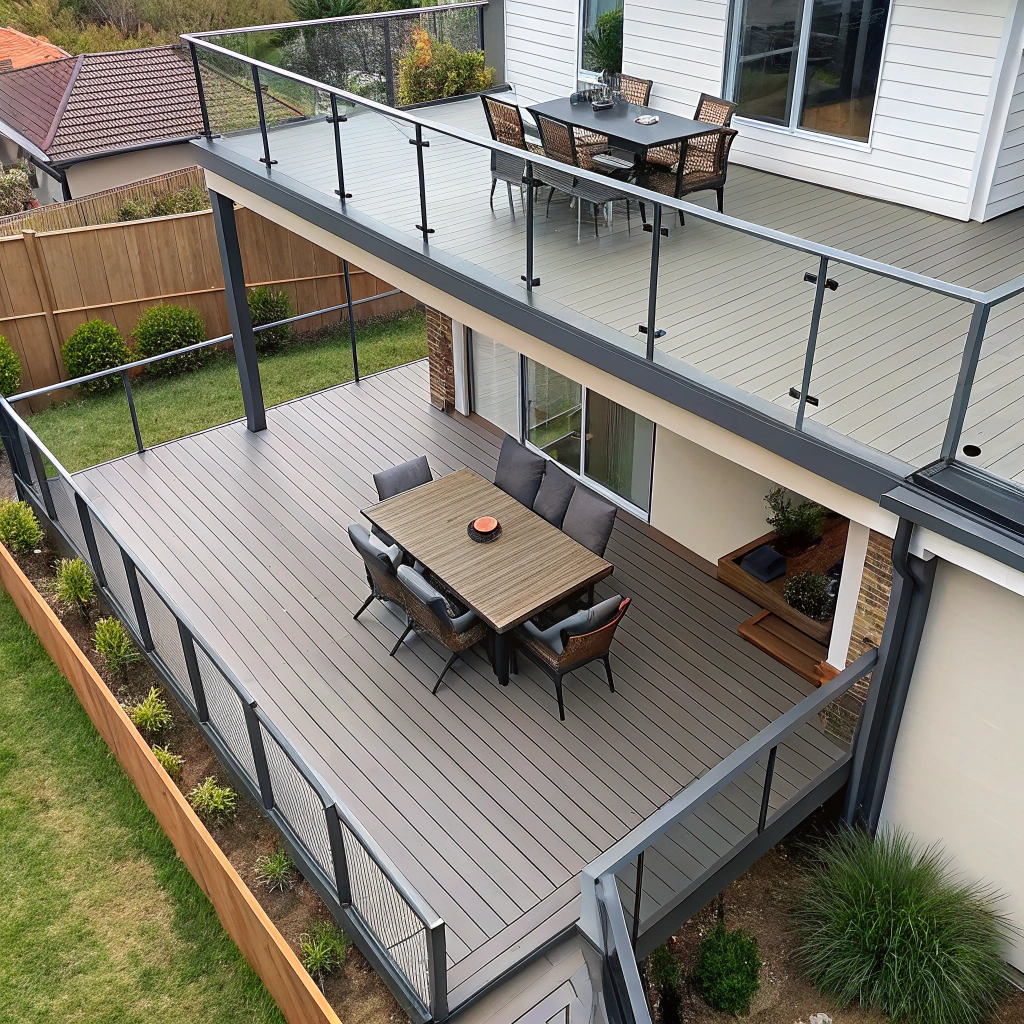
Connecting the Levels — Stairs, Landings, and Balustrade Requirements
Stairs and landings are what make a multi-level deck feel easy to move through — or not.
Stair placement affects everything. Put them in the wrong spot and they cut into usable space on the tier above, block furniture layouts, or create awkward traffic between levels. We position stairs to keep each level open and functional while maintaining a natural path through the deck.
Landing sizing between levels needs to meet minimum dimension requirements under AS 1657. A narrow landing between two flights of stairs doesn’t just feel wrong — it doesn’t meet the standard.
Any deck surface more than 1 metre above ground requires balustrades and handrails under AS 1657. On a multi-level build this typically applies to the upper tier and any intermediate landing above that threshold. Balustrade style is a finish choice — the structural fixing behind it is not.
Structural Engineering Behind a Multi-Level Build
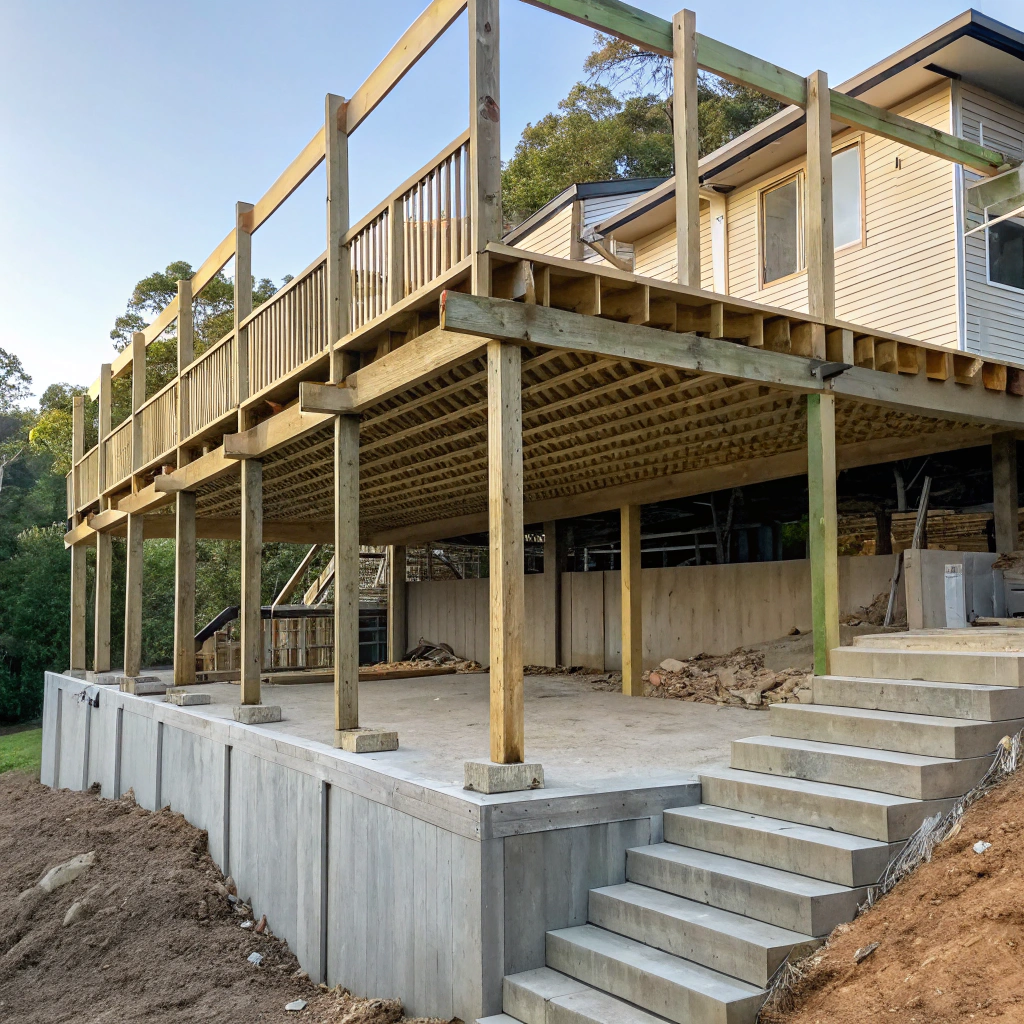
A multi-level deck carries more structural complexity than a single platform — and the engineering behind it needs to reflect that.
Bearer, Joist, and Post Sizing for Varying Heights: As deck height increases across a sloped site, bearer and joist sizing needs to increase with it. A post sitting 2.5 metres above ground carries a different load requirement than one sitting at 600mm. Every member in the frame is sized to suit the height and span it’s working at — not carried over from a standard single-level specification.
Footing Design and Engineer Certification: Post footings are designed around the height and load of each section of the build. On a sloped site, no two footings are necessarily the same. For any elevated section exceeding 1 metre above ground, engineer certification is required under the NCC. This isn’t optional — and it’s one of the clearest reasons multi-level deck building Newcastle isn’t a DIY project. A licensed builder carries the responsibility for getting this right from the ground up.


Timber vs Composite Decking Across Multiple Levels
Both timber and composite work well on a multi-level build. The right choice depends on your priorities around maintenance, budget, and finish. Here’s how they compare across the factors that matter most on a larger, multi-tier structure.
| Timber | Composite | |
|---|---|---|
| Appearance | Natural grain, varies between boards | Consistent finish across all levels |
| Maintenance | Requires regular oiling or sealing | Minimal — clean down periodically |
| Slip resistance on stairs | Needs applied coating or grooved profile | Built-in texture on most profiles |
| Cost at scale | Lower upfront cost on larger footprints | Higher upfront, lower ongoing cost |
| Longevity | 15–25 years with maintenance | 25–30 years with minimal upkeep |
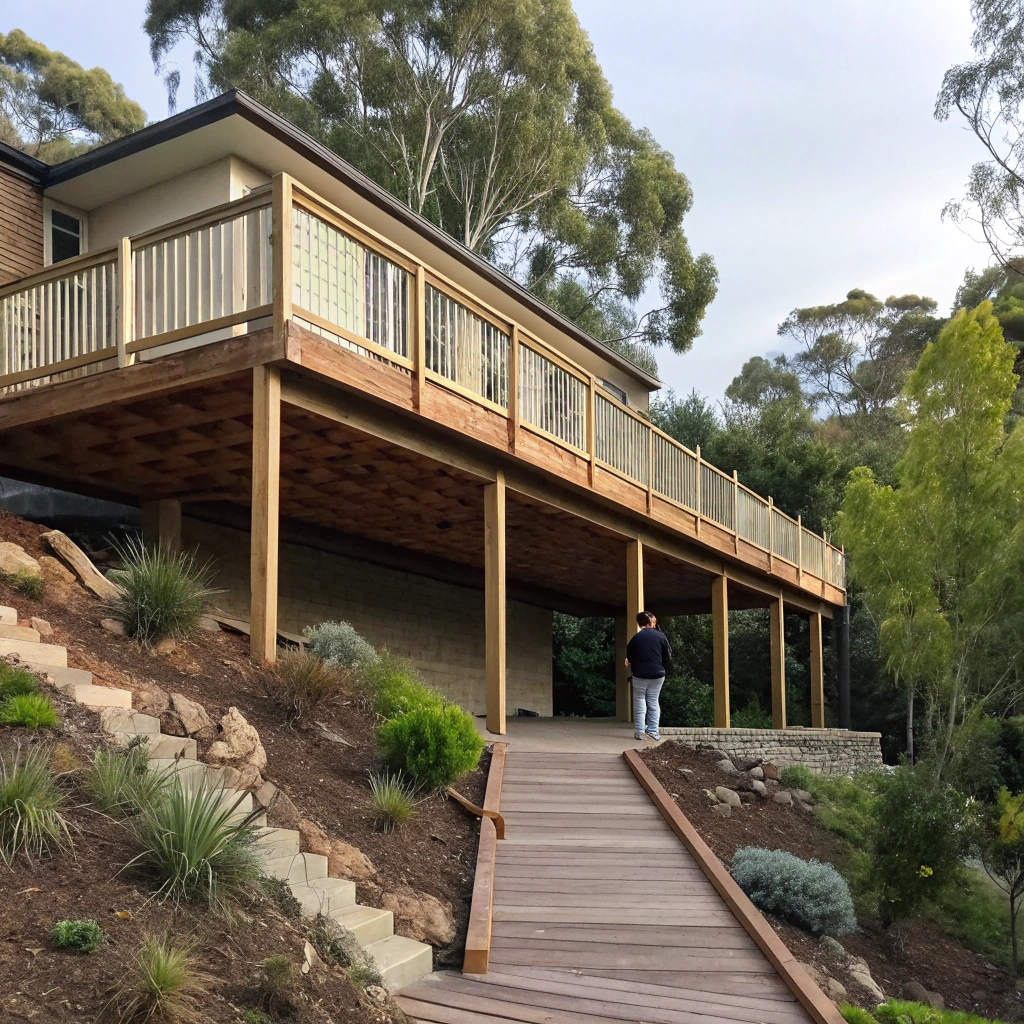
Integrating Your Multi-Level Deck With Your Home
A well-built multi-level deck doesn’t just sit outside your home — it connects to it properly at every level.
The upper tier typically aligns with your main living area, with sliding or stacker doors opening directly onto the deck surface. Getting the deck height right here matters — even a small step up or down between your internal floor and the deck surface disrupts the flow between inside and out.
A mid-level entry point works well where a home has a secondary door — a laundry exit, a side entry, or a lower ground floor opening. Rather than treating these as afterthoughts, we design the deck layout around them so every door has somewhere logical to land.
At the lower level, connection to a pool, garden, or side gate gives the whole structure a clear path from house to yard. Visual continuity between your indoor flooring and your decking material ties everything together — making the outdoor space feel like a deliberate extension of the home rather than something added on afterwards.
Council Approval and Compliance for Multi-Level Decks in Newcastle
Multi-level decks involve height, structure, and setbacks — so approvals need to be sorted early. Here’s how it works in Newcastle:
- Complying development (CDC) — decks that meet Newcastle City Council’s height and setback requirements can be approved without a full development application.
- Development application (DA) — required if your deck exceeds height limits, sits close to a boundary, or doesn’t meet CDC criteria.
- Licensed builder requirement — elevated structures in NSW must be built by a licensed builder. This is a legal requirement, not a preference.
- Engineer certification — any section exceeding 1 metre above ground requires engineer sign-off under the NCC.
- AS 1657 compliance — stairs, landings, and balustrades across all levels must meet AS 1657 requirements for rise, handrail height, and balustrade spacing.
Decking Newcastle manages the approval process end-to-end. Call us to discuss your site’s specific requirements.
Frequently Asked Questions
Multi-level decks vary depending on the number of tiers, site conditions, materials, and whether engineer certification or council approval is required. We provide a fully itemised quote after assessing your block — that way you know exactly what you’re paying for before anything starts.
It depends on the height and setback of the structure. Many multi-level decks qualify for complying development approval, which is a straightforward process. If your deck exceeds certain height or setback thresholds, a development application is required. We work this out for you early so there are no surprises.
Most multi-level builds take between two and four weeks on site, depending on the size and complexity of the structure. Approvals and engineering certification are arranged beforehand, so construction runs without interruption once it starts.
We build with both timber and composite decking. Timber suits buyers who want a natural finish and are happy to maintain it regularly. Composite suits those who want a low-maintenance surface that holds its appearance over time. We go through both options with you during the design stage.
Yes — steep blocks are exactly what multi-level decking is designed for. The steeper the fall, the more a tiered structure makes sense. We assess the gradient during the site visit and design the level placement around it.
We manage the approval process from start to finish — whether that’s complying development or a full development application. We also engage the structural engineer for certification on elevated sections. You don’t need to coordinate any of that yourself.
Get Your Free On-Site Quote From Decking Newcastle
Licensed deck builders — we assess your block, discuss your brief, and provide a fully itemised quote at no cost.
Multi-level deck building Newcastle done properly starts with understanding your site. We come to you, walk the block, and give you a clear picture of what’s possible before you commit to anything.
Call Decking Newcastle today or fill in the contact form below to book your free consultation.
